
Inyection Molding
From design to final piece
The cycle begins with the closing of the two halves of the mold. These metal parts, which contain the cavity shaped like the final part, are joined together and held firmly under high pressure. This pressure is critical to ensuring that the mold remains closed during injection and does not burst open due to the force of the molten material.
In this phase, the plastic material in the form of granules or pellets is fed into an injection unit. Inside this unit, a rotating screw heats, melts, and transports the plastic to the nozzle. Once the material is viscous and uniform, the screw forces it at high speed and pressure through the nozzle into the mold cavity, filling it completely.
Once the mold cavity has been filled, the screw continues to exert constant pressure to compensate for the shrinkage the plastic experiences as it cools and solidifies. This step ensures that the final part is free of defects and deformations. Simultaneously, the mold’s cooling system, through internal channels, cools the plastic until it completely solidifies and reaches the desired shape and hardness.
When the programmed cooling time has elapsed and the material is sufficiently rigid, the machine spindle retracts and the two mold halves open automatically. This is a precise movement that prepares the part for ejection.
In the final phase of the cycle, the mold ejection system, typically consisting of pins or plates, pushes the solidified part out of the cavity. Once the part drops or is removed by a robotic arm, the mold closes again, and the process restarts continuously to produce the next part.
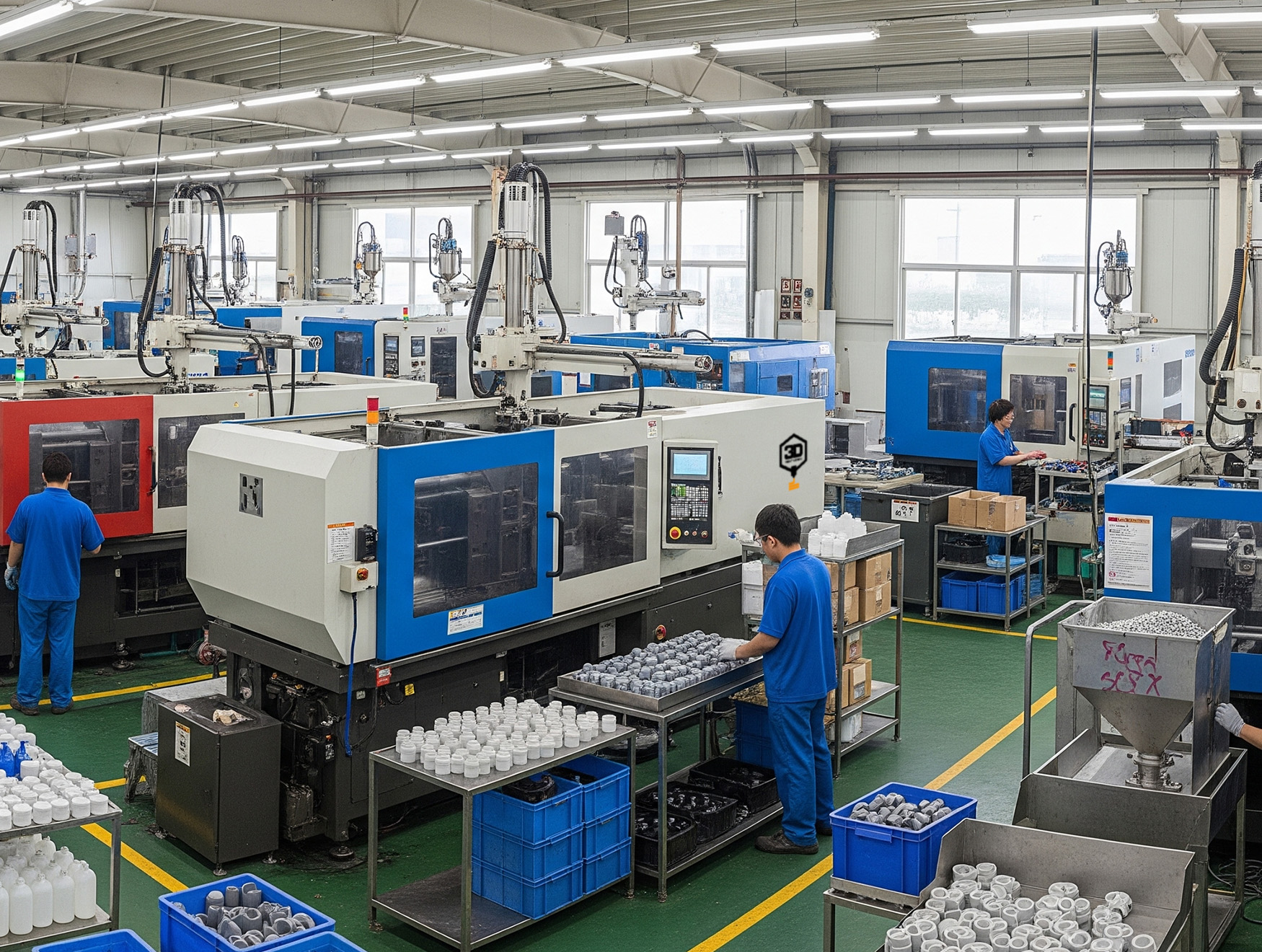
The three main benefits of injection molding are: high production speed and efficiency, allowing for the manufacture of large volumes of parts in rapid, continuous cycles; large-scale profitability, since although the initial investment in molds is high, the cost per part is drastically reduced when producing millions of units; and high precision and repeatability, ensuring that each part produced is identical to the last, with very tight tolerances, which is crucial for the manufacturing of complex components.
We manufacture in materials such as Acetal, Nylon, HDPE, Polyurethane, and Neoprene, among others.
- Mass production and cost efficiency
- Repeatability and consistent quality
- Versatility of materials
- High quality surface finish
- Production of complex geometries