
Additive Manufacture
Creation layer by layer
This is the initial phase, where the digital model of the object is created. Computer-aided design (CAD) software or a 3D scanner is used to generate the file. The design must be solid and error-free to ensure the part prints correctly. This step is crucial, as any errors in the design will be directly reflected in the final product.
Once the 3D model is created, it is exported to a standard file format, the most common being .STL (Standard Tessellation Language). The STL file represents the object as a mesh of triangles and is the language that 3D printers can interpret. This file is then imported into a slicer software, which divides the model into hundreds or thousands of very thin horizontal layers. This software also generates printing instructions, such as speed, temperature, and infill density.
In this phase, the 3D printer takes the instructions from the sliced file and begins to build the object. The machine deposits or solidifies material (plastic, metal, ceramic, etc.) layer by layer, following the geometry of the digital model. Depending on the additive manufacturing technology used, different methods are employed, such as molten filament extrusion, laser powder sintering, or solidifying liquid resin with light.
Once printing is complete, the object must be safely removed from the machine. In some processes, a cooling period is necessary to allow the material to completely solidify and prevent the part from losing its shape or mechanical properties. The method of removal varies depending on the material and technology and can be as simple as removing the part from a build platform or requiring cleaning of unsolidified support material.
This is the final phase, where the printed object undergoes various treatments to improve its finish and properties. Post-processing may include the removal of support structures, sanding to smooth the surface, washing with solvents to remove excess material, and, in some cases, additional heat treatments or curing to increase the strength and durability of the part. This step is critical to obtaining a functional and aesthetically acceptable final product.
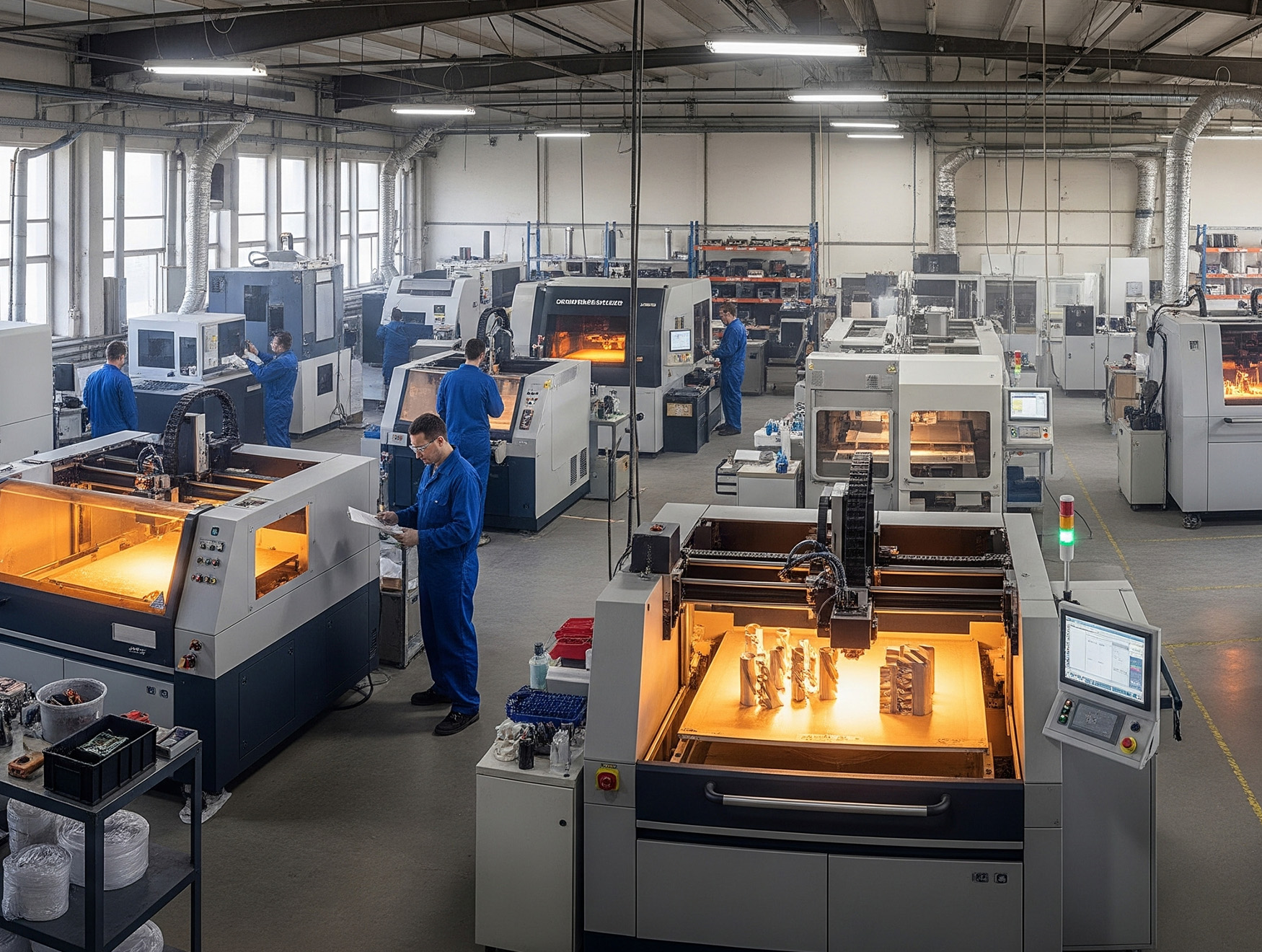
The three main benefits of additive manufacturing are: the ability to produce complex designs with high geometric freedom that would be impossible with traditional methods; reduced costs and material waste, since only the amount needed to build the object is used; and streamlined production, allowing for rapid prototyping and mass customization without the need for specific molds or tools.
We manufacture in materials such as PLA, CPE, TPU, PETG, Nylon, Polycarbonate, and Carbon Fiber, among others.
Additive Manufacturing also helps you with:
- Reduction of production costs
- Customization and production
- Rapid prototyping and design validation
- Supply chain optimization
- Production of efficient tools and molds