
Rubberized Rollers
Rubberized Rollers
Also known as a rubber-coated roller, it is a cylindrical piece of metal (usually steel) that has been covered with a layer of rubber or elastomer.
Rubber is not a simple coating; it is a chemical and physical bonding of the elastomer to the metal, ensuring that the coating does not come off during use.
We manufacture the rollers you need in your industry with specific properties such as dimensions, hardness (shore), and finish (material) for the most efficient production in your manufacturing process.
Printing Industry: They are crucial in printing presses for transferring ink evenly onto paper, cardboard, or other substrates.
Textile Industry: They are used to stretch, dry, and press fabrics, as well as to apply dyes or finishes.
Paper Industry: They help process, press, and roll large sheets of paper during production.
Packaging Industry: They are used in packaging machines to move, seal, and label products.
Material Conveyance: They are a fundamental part of conveyor belt systems, helping to move products along a production line.
Steel and Metalworking Industry: They are used to shape, coat, or transport sheet metal without damaging it.
Propiedades: Excelente resistencia a aceites, grasas, lubricantes y solventes derivados del petróleo. También ofrece una buena resistencia a la abrasión y al desgarro.
Aplicaciones:
Industria de la impresión: Rodillos entintadores y de arrastre, ya que resisten las tintas a base de aceite y solventes.
Industria automotriz: Rodillos para la producción de neumáticos, correas y otras piezas expuestas a aceites.
Industria del papel y textil: Rodillos de prensado y laminación donde puede haber contacto con aceites o productos químicos.
Properties: It stands out for its high resistance to weathering, ozone, UV rays, acids, alkalis, and water. It is ideal for outdoor applications. It is not compatible with oils and petroleum-based solvents.
Applications:
Printing industry: Rollers for UV-curing inks, as EPDM is highly resistant to these inks.
Construction industry: Rollers for applying waterproofing membranes.
Conveyor systems: Rollers for conveyor belts in humid or outdoor environments.
Properties: Excellent resistance to high and low temperatures (up to 260°C or more), non-toxic, low adhesion (non-stick), and good chemical resistance. It is ideal for sanitary applications.
Applications:
Food and pharmaceutical industry: Conveyor and processing rollers due to their food compatibility and sterilization resistance.
Textile and packaging industry: Rollers for hot lamination, sealing, and adhesive release processes.
Properties: Offers exceptional resistance to abrasion, tearing, and cutting. It is harder than most rubbers, making it ideal for heavy-duty applications.
Applications:
Paper and cardboard industry: Pressing, laminating, and conveying rollers.
Metal industry: Rollers for shaping metal sheets without damaging them.
Mining industry: Conveyor rollers that handle abrasive materials such as rocks and minerals.
Properties: Natural rubber is highly elastic, with excellent abrasion and tear resistance. SBR is a synthetic substitute with similar properties, ideal for applications where there is no contact with oils.
Applications:
Conveyor belts: Rollers and pulleys requiring high abrasion resistance.
Textile industry: Rollers for stretching and pressing fabrics.
Laminating processes: Rollers requiring good grip and contact with the substrate.
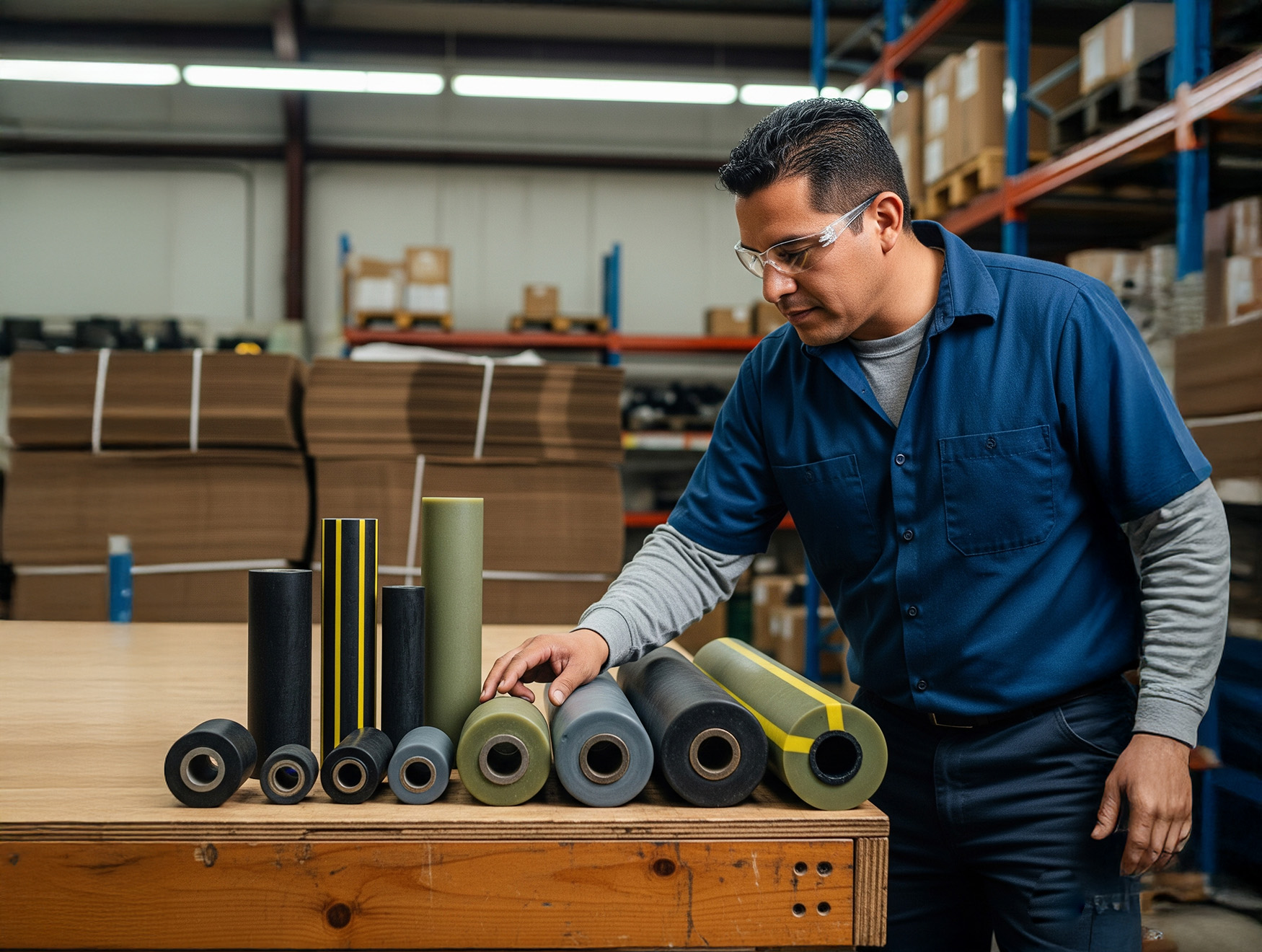
Rubber-coated rollers are essential in industry due to three main benefits: first, their high friction and grip allow for smooth and precise material handling, crucial in printing and conveying. Second, the rubber coating protects sensitive materials and the machinery itself, minimizing damage from impact or abrasion. Finally, their chemical and abrasion resistance provides superior durability in harsh industrial environments, ensuring consistent performance and reducing maintenance and replacement costs.
- Product protection
- Better grip and traction
- Shock and vibration absorption
- Resistance to external agents
- Versatility in material and hardness (shore)
- Easy maintenance